

A practical breakdown of Class 1B building certification: what it is, why it matters, what it costs, and what happens if you ignore it.
If you own or are planning to invest in a co-living property in Australia, three numbers could define whether your investment is legal, profitable, or both: 1A, 1B, and 3. Understanding the difference between these building classifications and specifically what it means to hold a Class 1B certification is non-negotiable for anyone operating in the co-living space.
This guide cuts through the jargon and gives you a clear, comprehensive understanding of the 1B certification: what it is under the National Construction Code, who needs it, how to get it, what it costs, and the very real consequences of ignoring it.
Table of Contents
- What Is a Class 1B Certification
- How Does 1B Differ from 1A and Class 3
- Who Needs a 1B Certification
- Key Requirements to Achieve 1B Certification
- Do You Need a Planning Permit or a Building Permit
- Can You Convert a 1A Property to 1B
- Does 1B Certification Cost More to Build
- Sub-Metering Utilities: What You Need to Know
- The Penalties for Non-Compliance: Why This Is Serious
- Frequently Asked Questions
- Final Thoughts: Getting It Right from the Start
What Is a Class 1B Certification
A Class 1B certification is a building classification under Australia’s National Construction Code (NCC) . It is the legal designation required for a residential property that will house more than three unrelated tenants under a co-living or shared accommodation arrangement.
In plain English: if you want to legally rent out a property to four or more unrelated people, the building must be certified as Class 1B. Without this certification, operating such a property is not just risky, it is illegal.
“1B is a building classification under the National Construction Code. It sits between 1A, which is regular residential, and Class 3, which is commercial. The 1B allows for the property to be rented out to more than three unrelated parties.”
The 1B classification sits in a deliberate middle ground. It is not a full commercial classification (like a hotel or boarding house), but it acknowledges that a property accommodating multiple unrelated adults carries different safety responsibilities than a standard family home.
1 National Construction Code (NCC), Australian Building Codes Board (ABCB). See https://ncc.abcb.gov.au for the current edition.
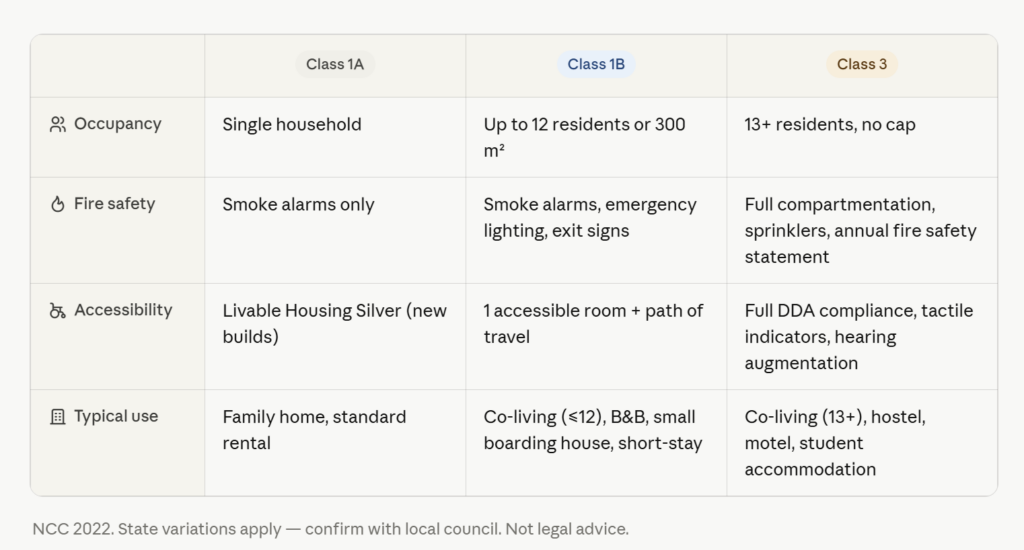
Comparison of Class 1A, 1B and 3 building classifications under the National Construction Code.
How Does 1B Differ from 1A and Class 3
To understand 1B, it helps to understand the broader classification spectrum:
- Class 1A: Standard residential dwellings. This covers the vast majority of homes in Australia: houses, townhouses, and units occupied by a single family or a small number of related or unrelated occupants (up to three unrelated tenants). No special certification is needed beyond a standard building permit.
- Class 1B: Shared residential accommodation for four or more unrelated occupants. The NCC additionally caps Class 1B dwellings at no more than 12 occupants and a floor area not exceeding 300 m². This is the co-living sweet spot; the property remains residential in character but must meet additional standards for fire safety, accessibility, and occupant amenity.
- Class 3: Commercial accommodation. This includes hotels, motels, backpacker hostels, and large boarding houses. The construction standards and compliance requirements are significantly more demanding (and expensive) than 1B.
For co-living investors, the 1B classification is the target. It enables you to maximise rental yield by accommodating more tenants without the prohibitive costs of a full commercial build.
Who Needs a 1B Certification
Any co-living property that will house more than three unrelated tenants must be 1B certified. In practice, this covers:
- Purpose-built co-living properties with four or more bedrooms
- Investor properties specifically designed for house-sharing or rent-by-room arrangements
- Properties that will be managed under a co-living model where individual leases are issued to unrelated parties
If your property has three bedrooms or fewer and will accommodate no more than three unrelated tenants, you can operate under a Class 1A classification. The moment you move to four unrelated tenants, 1B is mandatory.
Key Requirements to Achieve 1B Certification
Achieving a 1B certification is not simply a matter of ticking a box at the end of construction. It requires deliberate design and construction decisions from day one. Here are the core requirements:
Accessible Bathroom
At least one bathroom in the property must be an accessible bathroom. This requirement is rooted in anti-discrimination principles: a co-living property should be accessible to tenants with mobility challenges or disability. In practice, this means one tenant simply gets a larger, more spacious bathroom, hardly a dealbreaker.
“That’s so you’re not discriminating on the type of tenant that you can have within the property. Somebody might have accessibility requirements and they want to live in this type of arrangement, so they shouldn’t be excluded.”
Fire Safety Compliance
The 1B certification has a strong focus on fire safety, reflecting the reality that more people under one roof means more lives are at risk if something goes wrong. Requirements typically include:
- Hard-wired smoke alarms throughout the property (not battery-operated)
- Adequate number of clearly defined emergency exits
- Fire-safety infrastructure proportionate to the maximum occupancy
The NCC caps Class 1B dwellings at 12 occupants and 300 m² of floor area. Most well-designed co-living properties sit well below the occupancy cap; a nine-bedroom home, for example, typically houses nine residents.
Sound Insulation
While not always explicitly mandated as a strict 1B requirement, double-insulated walls and soundproofing measures are considered best practice and align with the spirit of what 1B certification is trying to achieve. When multiple unrelated adults share a home, acoustic privacy is essential for liveability and tenancy retention.
Kitchenette and Additional Amenities
Depending on the design, 1B properties may require additional shared amenities such as kitchenettes or common areas. These contribute to the overall habitability of the property for multiple occupants.
Registered Building Surveyor
A registered building surveyor must be engaged from the start of the project not just at the end. The surveyor assesses compliance at the design stage and then formally certifies the building upon completion.
“We need a building surveyor all the way through, start to finish, quite literally. The certification comes from a registered building surveyor who ticks boxes on design first, then at completion.”
Do You Need a Planning Permit or a Building Permit?
This is one of the most common points of confusion for investors entering the co-living space. The short answer: in most cases, you only need a building permit, not a planning permit.
A planning permit (or development permit) is required when you want to build something outside the approved envelope for a given location for example, if you want to exceed zoning height limits or build a type of dwelling not permitted under local planning rules.
For most purpose-built 1B co-living properties, if the project falls within the approved use and design envelope for the area, a standard building permit is all that is required. This simplifies the approval process considerably and removes a significant layer of cost and delay.
That said, planning rules vary materially between local councils and between states. Always confirm the specific requirements with your building surveyor and town planner before commencing.
Can You Convert a 1A Property to 1B?
Yes, it can be done and there are specialist companies that focus on exactly this type of conversion. However, it is not a simple process.
Converting an existing 1A home to meet 1B certification standards typically involves:
- Significant structural or layout modifications to create individual ensuite rooms
- Installing the required accessible bathroom
- Upgrading fire safety infrastructure including smoke alarms and exits
- Adding soundproofing and insulation between rooms
- Engaging a building surveyor to oversee the renovation and certify the outcome
All of this requires substantial upfront capital. You need to purchase the property, then fund the renovation before any rental income flows.
“You can get a 1A dwelling and if it’s big enough and it’s got the right structure in place, you can renovate it to become a 1B certified property. But it’s quite an undertaking.”
Many experienced co-living investors and developers prefer purpose-built 1B properties. The reason is straightforward: when you build from scratch, you eliminate unknown variables. You design for the exact tenant profile you are targeting, you know the outcomes before construction begins, and you avoid the risk of discovering expensive structural surprises mid-renovation. (For a deeper look at why purpose-built typically beats retrofit on returns, see our pillar guide: [Co-Living Investment: The New Way to Build Wealth Through Residential Property in Australia].)
Does 1B Certification Cost More to Build?
Yes, but the premium is reasonable relative to the yield uplift that co-living generates.
The additional cost of building to 1B standard versus a standard 1A residential build typically includes:
- Accessible bathroom fitout (wider doorways, grab rails, larger footprint)
- Hard-wired smoke alarm system throughout
- Additional exits where required
- Double-insulated walls and soundproofing between rooms
- Kitchenette or additional shared amenity spaces
- Building surveyor fees across the full duration of the project
These are real costs, but they are also fixed costs that are offset by the substantially higher rental income that a 1B co-living property generates compared to a standard single-lease dwelling. A nine-bed property at around $380 a room returns $179,010 a year in gross rent, against $45,000 for a standard investment property at the same $1.5m price. Average figures based on most recent projects.
Want to model the build cost vs. yield trade-off for a specific site? Book a 30-minute strategy call with our team.
Sub-Metering Utilities: What Co-Living Investors Need to Know
A common feature of well-managed co-living properties is that utilities are included in each tenant’s weekly rent. This is part of the value proposition for the tenant: a fully furnished room, bills included, no hassle.
But how do you protect yourself as an investor from tenants running up enormous power or water bills?
The answer is sub-metering. Individual rooms can be sub-metered for electricity and water usage. Each tenant is provided with a usage cap included in their rent. If they exceed that cap, they pay the difference.
“We have the rooms sub-metered just to protect investors from over-usage. If any residents go over their usage cap, then they pay the difference.”
Sub-metering is not a 1B certification requirement; it is a best-practice property management measure. It protects your bottom line and encourages responsible usage without penalising tenants for normal, reasonable consumption.
The Penalties for Non-Compliance: Why This Is Serious
This section deserves your full attention. If you are operating or considering operating a co-living property with more than three unrelated tenants and you do not have 1B certification, you are exposed to severe consequences.
Financial Penalties
Penalties for operating a non-certified property vary by state and territory because building enforcement is administered at that level. In Victoria, penalties under the Building Act 1993 are calculated in penalty units that, for serious breaches, can exceed AUD $100,000 for individuals and considerably more for body-corporate offenders . New South Wales applies penalties under the Environmental Planning and Assessment Act 1979 , and other states administer their own equivalents. Depending on jurisdiction and the severity of the breach, total exposure for a single non-compliant property can run into the hundreds of thousands of dollars before any incident has occurred.
Critically, you do not need to wait for an incident to occur. A single complaint from a tenant, a neighbour, or any other party can trigger an investigation. If the property is found to be non-compliant, the penalties apply regardless of whether anything went wrong.
2 Building Act 1993 (Vic). Penalty units are indexed annually under Victorian law; refer to the Victorian Building Authority for current rates.
3 Environmental Planning and Assessment Act 1979 (NSW). Refer to the NSW Department of Planning and Environment for current penalties.
“You’re one aggrieved tenant away from a potentially six-figure fine. Something doesn’t have to happen for somebody to get penalised.”
Criminal Liability
Beyond financial penalties, non-compliance can in some jurisdictions translate into criminal charges. Penalty units can be converted into custodial sentences for the most serious cases. While regulators are unlikely to pursue imprisonment for technical breaches, if a serious incident, a fire, an injury, a death occurred at an uncertified property, prosecutors would almost certainly make an example of the responsible party.
The calculus is simple: the cost of building to 1B standard is a fraction of the maximum financial exposure, and incomparably smaller than the human and legal consequences of a serious incident at an uncertified property.
Reputational and Operational Risk
An investigation or fine would also likely result in the property being taken offline while compliance issues are rectified, costing rental income for an indefinite period. In a worst-case scenario, the property may need to be de-tenanted entirely.
Frequently Asked Questions
Key Takeaways
- Class 1B is the National Construction Code (NCC) classification required for residential properties housing more than three unrelated tenants, the legal basis for compliant co-living.
- 1A covers standard homes (up to three unrelated occupants), 1B covers shared residential dwellings, and Class 3 covers commercial accommodation like hotels.
- The NCC caps Class 1B dwellings at 12 occupants and a floor area no greater than 300 m².
- Operating an uncertified co-living property exposes the owner to substantial state-based penalties and potential criminal liability; a single complaint can trigger an investigation.
- Purpose-built 1B is generally cheaper, faster, and lower-risk than retrofitting an existing 1A dwelling.
Final Thoughts: Getting It Right from the Start
The 1B certification is not red tape for its own sake. It exists to protect the people living in co-living properties ensuring that when multiple unrelated adults share a home, the building is safe, inclusive, and fit for purpose.
For investors, the certification also provides something invaluable: certainty. A purpose-built, 1B-certified co-living property is a legal, compliant, bankable asset. It can be financed, insured, and managed with confidence. A non-compliant property, by contrast, is a liability waiting to materialise.
The pathway to a successful co-living investment starts with design engaging a builder experienced in 1B construction, appointing a registered building surveyor from day one, and treating compliance not as an afterthought but as the foundation of the entire project.
“It’s not just a financial penalty; those penalty units can in some cases be translated into actual prison time. You need to do it properly.”
Done right, a Class 1B co-living property delivers strong rental yields, high occupancy, and a growing tenant demographic. Done wrong or not certified at all, the downside is catastrophic.
Get the certification. Build it properly. The numbers make sense.
Book a 30-minute strategy call with our team no obligation, and we’ll tell you straight whether co-living fits your situation.
Related Reading
- Co-Living Investment: The New Way to Build Wealth Through Residential Property in Australia
- SMSFs and Co-Living Properties: Building Tax-Effective Retirement Wealth
Disclaimer: This article is intended for general informational purposes only and does not constitute legal, financial, or construction advice. Always consult a registered building surveyor, licensed builder, and qualified financial adviser before making investment decisions.