Answering: Why does Victoria treat nine bedrooms as the planning threshold for a rooming house that can proceed without a planning permit, and what still has to be approved anyway?
Estimated reading time: 13 min read
Nine bedrooms is the planning cap in Clause 52.23 of the Victoria Planning Provisions. A rooming house that stays at or under that cap, and meets the other conditions in the clause, can be used and built in many residential zones without a planning permit. Go to ten bedrooms and the exemption falls away.
If you are comparing co-living operators from your kitchen table, nine rooms can look like a product slogan. It is not. It is the largest domestic-scale rooming house Victoria will treat as planning-exempt in the zones the clause covers. The Harmony Group designs a purpose-built nine-bed to that shape from the start: nine rooms, nine bathrooms, single storey, with shared living space, on one title. The team describes that shape as part of The Harmony Formula: nine bed, high-end, good location, established area.
The planning exemption is not a free pass. A building permit is still required. So is registration as prescribed accommodation with the local council. Operator licensing sits on a different statute again. If someone tells you a nine-bed needs no approvals at all, they are not describing the Victorian system.
Key Insights
- Clause 52.23 exists to facilitate domestic-scale rooming houses. The planning-permit exemption holds only when every listed condition is met.
- The conditions investors notice first are no more than nine bedrooms, no more than 300 square metres of floor area, and no more than 12 residents.
- The exemption does not cancel a building permit, council registration as prescribed accommodation, operator licensing, or the rooming house minimum standards.
- Class 1b under the National Construction Code uses the same 300 square metre and 12-person ceiling. That is a building classification, not a planning permit.
- The Harmony Group builds in Melbourne. Investors come from every state. Nine bedrooms is a planning envelope, not a marketing preference.
Table of Contents
- Clause 52.23 is the planning rule that sets the cap
- The conditions that have to be met together
- What the planning exemption does not remove
- Planning sits beside building class, registration and licensing
- Why a purpose-built nine-bed is drawn to that shape
- What to check if you are comparing operators
- Frequently Asked Questions About the Nine-Bedroom Planning Cap
Clause 52.23 is the planning rule that sets the cap
Clause 52.23 is the particular provision in the Victoria Planning Provisions that deals with rooming houses. Its stated purpose is to facilitate the establishment of domestic-scale rooming houses. It applies to the use and development of land for a rooming house.
The clause does two separate jobs. Clause 52.23-2 is a use exemption: in listed zones, you do not need a planning permit to use the land as a rooming house if every use condition is met. Clause 52.23-3 is a buildings and works exemption: in a slightly shorter list of residential zones, you do not need a planning permit to construct the building if every development condition is met.
The use exemption covers a listed set of residential, mixed-use and commercial zones, including the General Residential Zone, Neighbourhood Residential Zone, Residential Growth Zone, Mixed Use Zone and Township Zone. The buildings and works exemption is limited to six of the residential zones. Both lists are written into the clause. They were last updated by planning scheme amendments VC274 (use exemption, 28 February 2025) and VC257 (buildings and works exemption, 25 February 2025).
Nine bedrooms is the bedroom cap in both exemptions. Stay inside the clause and many Melbourne residential sites can proceed without a planning permit for the rooming house use or the buildings and works. Step outside it and the rooming house becomes a permit-required use or development, assessed on its merits. That is why operators who work inside Victorian planning talk about nine rooms. The number is written into the statewide provision.
The conditions that have to be met together
Councils that publish guidance, including Wyndham City, treat the exemption as a single package. Miss one condition and it does not apply. Drawn from both subclauses, the conditions investors need are these.
The proposal has to be a rooming house in the first place. The planning scheme takes that definition from the Residential Tenancies Act 1997: a building with rooms available for rent, accommodating four or more people, who share its facilities. Wyndham’s guidance on whether a proposal is a rooming house adds that a room with its own kitchen, bathroom and toilet is a self-contained apartment rather than a room, and that a nine-bedroom rooming house can include at most two self-contained rooms. A proposal that fails the definition is assessed as a different use and does not get the Clause 52.23 exemptions.
No more than nine bedrooms. Both exemptions cap bedrooms at nine. A tenth bedroom is the cleanest way to fall out.
No more than 300 square metres of floor area. The clause measures total floor area of all buildings on the land from the outside of external walls or the centre of party walls, excluding outbuildings. That is the same ceiling the National Construction Code uses for a Class 1b boarding house, guest house or hostel.
No more than 12 persons accommodated. That person cap sits in the use exemption. A project that relies on both exemptions still has to satisfy it.
Bedrooms can only be accessed from within the building. Wyndham’s guidance puts it as each bedroom being reached from a shared entry inside the building.
A minimum garden area in some zones. If the development is in the General Residential Zone or the Neighbourhood Residential Zone, garden area has to be provided in line with the zone. That is a zone rule the clause imports.
Shared entry facilities and common areas, including a kitchen and living area. The buildings and works exemption is explicit on this. Wyndham adds that the living area is separate from the kitchen and dining area, and that it will not accept a couch drawn on a floor plan in an entry way or hallway.
One more use condition is easy to skip: any condition opposite “rooming house” in the zone table of uses, or in the schedule to the zone, still has to be met. The exemption sits on top of the zone table. It does not wipe the zone table out.
All of those conditions have to be true together. A nine-bedroom building at 320 square metres is not planning-exempt. Neither is a nine-bedroom building with no shared living room, nor a ten-bedroom building that is otherwise modest.
What the planning exemption does not remove
Wyndham City’s published guidance is blunt. If the proposal meets the requirements, you do not need a planning permit. You must still obtain a building permit. You must still register as a prescribed accommodation business with the council’s environmental health unit.
A planning-permit exemption is only an exemption from the planning permit. A registered building surveyor still assesses the design against the National Construction Code and issues a building permit, then an occupancy permit, before anyone can live there.
Rooming houses are prescribed accommodation under the Public Health and Wellbeing Act 2008 and the Public Health and Wellbeing (Prescribed Accommodation) Regulations 2020. Registration is with the local council. Licensing with Consumer Affairs Victoria is a third layer, under the Rooming House Operators Act 2016. Consumer Affairs Victoria is clear that licensing does not change the obligation to register the premises, and that one process does not depend on the other.
Minimum standards still apply. The Residential Tenancies (Rooming House Standards) Regulations 2023 set privacy, security, safety and amenity standards. Meeting Clause 52.23 does not switch those standards off.
The honest sentence is not “nine bedrooms means no approvals.” It is “nine bedrooms, inside the rest of the clause, can mean no planning permit.” The building permit, occupancy permit, council registration and operator licensing remain on the list.
Planning sits beside building class, registration and licensing
Investors comparing operators often hear four labels used as if they were the same stamp: planning exemption, Class 1b, council registration, and a rooming house operator licence. They are four different layers.
Class 1b is a building classification under the National Construction Code. The Australian Building Codes Board describes a Class 1b building as a boarding house, guest house or hostel that has a floor area less than 300 square metres and ordinarily has less than 12 people living in it. That is why a well-drawn nine-bed sits inside both envelopes. Classification is decided through the building permit. It does not replace Clause 52.23. The Class 1b guide walks that layer properly.
Council registration is a public health step. The premises are registered as prescribed accommodation and inspected against the prescribed accommodation regulations. It is not the planning permit, and it is not the operator licence.
Operator licensing is about the person or company running the rooming house, not the floor plan. Consumer Affairs Victoria requires the operator to be licensed before they start operating. Building owners who lease the property to an operator do not need that licence themselves. The licence is granted by the Business Licensing Authority.
Those layers are the subject of the licence, registration and Class 1b article. Land tax is a different question again. The rooming house land-tax exemption has its own tests. That is covered in the land tax guide. Planning exemption is only one box, and it is the box that makes nine bedrooms the number you keep seeing.
Why a purpose-built nine-bed is drawn to that shape
The Harmony Group’s definition of The Harmony Formula is nine bed, high-end, good location, established area. Nine bed is the first term because that is the planning and building envelope in which a domestic-scale rooming house can be designed on purpose, rather than forced into an existing house after the walls are already up.
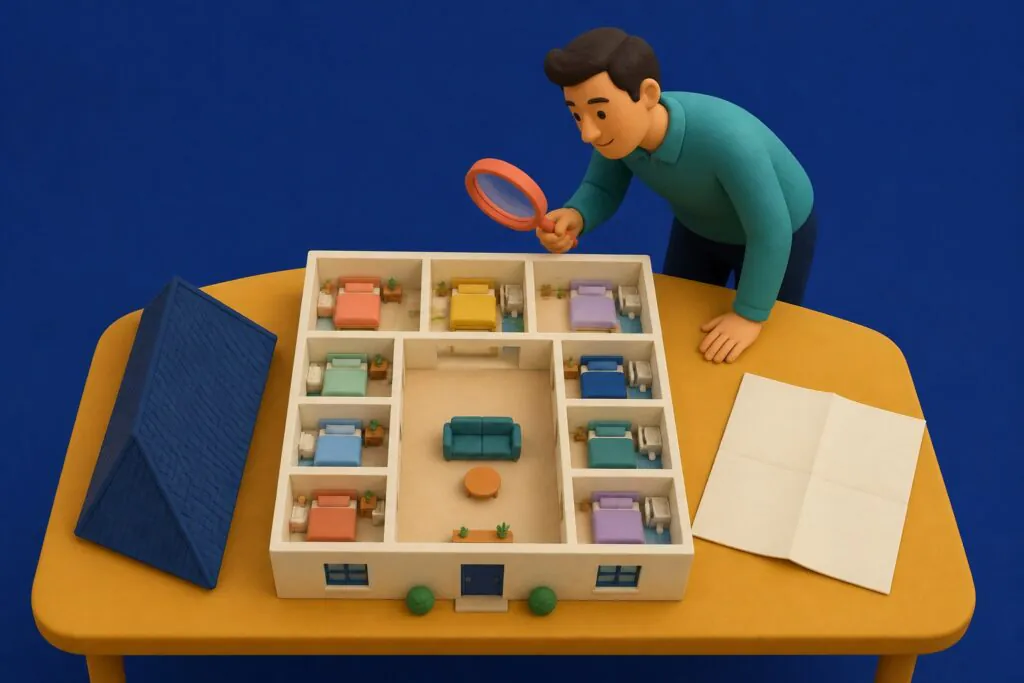
A purpose-built nine-bed is one knock-down-rebuild site in Melbourne’s middle ring, one title, nine rooms and nine bathrooms, single storey, plus shared living space. Nine people live in it, each on their own lease. A specialist property manager runs it. You own the whole building. It is direct ownership, not a fund, a syndicate or a part-share.
That layout is drawn to Clause 52.23. Nine bedrooms stay inside the cap. Shared living space is required by the buildings and works exemption. Single storey is one of the Build Formula’s non-negotiables, and the 300 square metre test is applied to the total floor area of all buildings on the land. Internal access from a shared entry is how the bedrooms are reached. Garden area is a site-selection question in the zones that demand it.
The 118-point method is how the team chooses the site. Council and planning settings sit inside that method because a site that cannot carry a domestic-scale rooming house is the wrong site. Class 1b certification is confirmed on every property before commitment, and most opportunities do not survive the method: the team turns down around 85% of what it assesses. The team brings 15+ years of specialist accommodation experience. Clients pay Harmony $0. Builders pay the same fee at settlement, so there is no incentive to prefer one builder over another.
Someone could apply for a planning permit and try for ten or twelve rooms. That is a different project: assessed, able to be refused, and outside the domestic-scale exemption the clause was written to create. The Harmony Formula stays at nine because that is the shape the statewide provision already contemplates.
We build in Melbourne. Our investors come from every state. The planning rule is Victorian. The investor does not have to live in Victoria to need it explained clearly.
What to check if you are comparing operators
If you are mid-comparison, the useful questions are about the envelope, not the brochure.
Ask whether the building is purpose-built as a nine-bed, or adapted from an ordinary house. An adapted house has to fight floor area, shared space, internal access and garden area after the structure already exists. A purpose-built project can be drawn to those tests from the first plan.
Ask which clause they are relying on, by name. Clause 52.23 is the statewide provision.
Ask what still needs approval after the planning exemption. The right list includes a building permit, an occupancy permit, council registration as prescribed accommodation, and a licensed operator. If the answer is that nothing else is required, the answer is wrong.
Ask how the site was chosen. For Harmony, that is the 118-point method, and planning controls are part of the data rather than a surprise later.
Ask who owns the building, how many leases sit on the title, and who manages day to day. For a Harmony nine-bed, those answers are set out above.
Ask who pays the person walking you through it, and whether that fee changes with the builder they recommend.
Those questions will tell you whether nine bedrooms is being used as a planning fact or as a sales number.
Frequently Asked Questions About the Nine-Bedroom Planning Cap
Q: Does a nine-bedroom rooming house need a planning permit in Victoria?
Not if the building is a rooming house as the planning scheme defines it and every condition in Clause 52.23 is met, in a zone the clause covers. The use exemption and the buildings and works exemption each have their own list. Nine bedrooms is necessary. It is not sufficient on its own. Floor area, resident numbers, internal access, garden area in some zones, and shared kitchen and living space still have to be true. If any condition fails, a planning permit is required.
Q: What happens if the building has ten bedrooms?
The Clause 52.23 bedroom cap is nine. A tenth bedroom means the planning-permit exemption does not apply. The proposal is then assessed as a permit-required rooming house in the relevant zone. That can be approved, conditioned or refused. It is a different planning path from the domestic-scale exemption the clause creates.
Q: Is Class 1b the same thing as the Clause 52.23 exemption?
No. Class 1b is a National Construction Code classification for a boarding house, guest house or hostel under 300 square metres that ordinarily houses fewer than 12 people. Clause 52.23 is a planning provision about when a rooming house needs a planning permit. The two ceilings look similar because they were written for domestic-scale shared housing. One does not replace the other.
Q: If the project is planning-exempt, are a building permit and registration still required?
Yes. Wyndham City’s guidance states that you must still obtain a building permit and register as prescribed accommodation with council. Operator licensing with Consumer Affairs Victoria is a separate requirement under the Rooming House Operators Act 2016. Minimum standards under the Residential Tenancies (Rooming House Standards) Regulations 2023 still apply.
Q: Why build nine rooms rather than eight or twelve?
Eight rooms can also sit inside the exemption. Twelve rooms cannot, because the bedroom cap is nine and the resident cap is 12. Nine rooms is the largest bedroom count the statewide clause allows without a planning permit, while still leaving shared living space and a 300 square metre floor area to work with. That is the planning reason the team puts “nine bed” first in The Harmony Formula.
Learn how a nine-bed co-living building is actually put together
If you want the planning rule in context, start with Harmony’s free co-living education program rather than a conversation. About 45 minutes covers the core. It covers what you would own, how a purpose-built nine-bed is designed and run, and where planning, building classification and management sit. Finish any 9 modules and a booking link opens for a one on one with one of the directors. If co-living isn’t suitable for you, we’ll tell you why.
Related reading on planning, certification and the nine-bed shape
- Rooming house licence, council registration and Class 1b in Victoria
- What Class 1b certification means for a co-living investor
- What The Harmony Formula is, and why it produces nine-bed properties
- Land tax and the rooming house exemption on a nine-bed
- Purpose-built co-living compared with a rooming house
Citations
- Clause 52.23 Rooming House, Victoria Planning Provisions via planning.vic.gov.au BRIM extract, amendments VC152 (26 October 2018), VC257 (25 February 2025) and VC274 (28 February 2025)
- Exemptions, Wyndham City Council
- Is my proposal a Rooming House?, Wyndham City Council
- Rooming house operators licensing scheme, Consumer Affairs Victoria, last updated 9 April 2024
- Building classifications, Australian Building Codes Board
- Public Health and Wellbeing (Prescribed Accommodation) Regulations 2020, Victorian consolidated regulations on AustLII
- Residential Tenancies (Rooming House Standards) Regulations 2023, legislation.vic.gov.au
- Rooming house – minimum standards, Consumer Affairs Victoria
General information only. The Harmony Group provides general information about property and co-living investment, not personal financial, tax or legal advice, and does not hold an Australian Financial Services Licence (AFSL). It does not account for your objectives, financial situation or needs, so consider its appropriateness and seek advice from a licensed financial adviser, mortgage broker, accountant or the ATO before acting. Past performance is not a guide to future results and historical figures may not be repeated. The 2027 negative gearing reform was enacted on 26 June 2026 and applies from 1 July 2027. The definition of a new residential dwelling is still being settled after Treasury’s consultation, so whether a nine-bed is an eligible new build remains unsettled. Other tax or regulatory measures described are subject to change.