
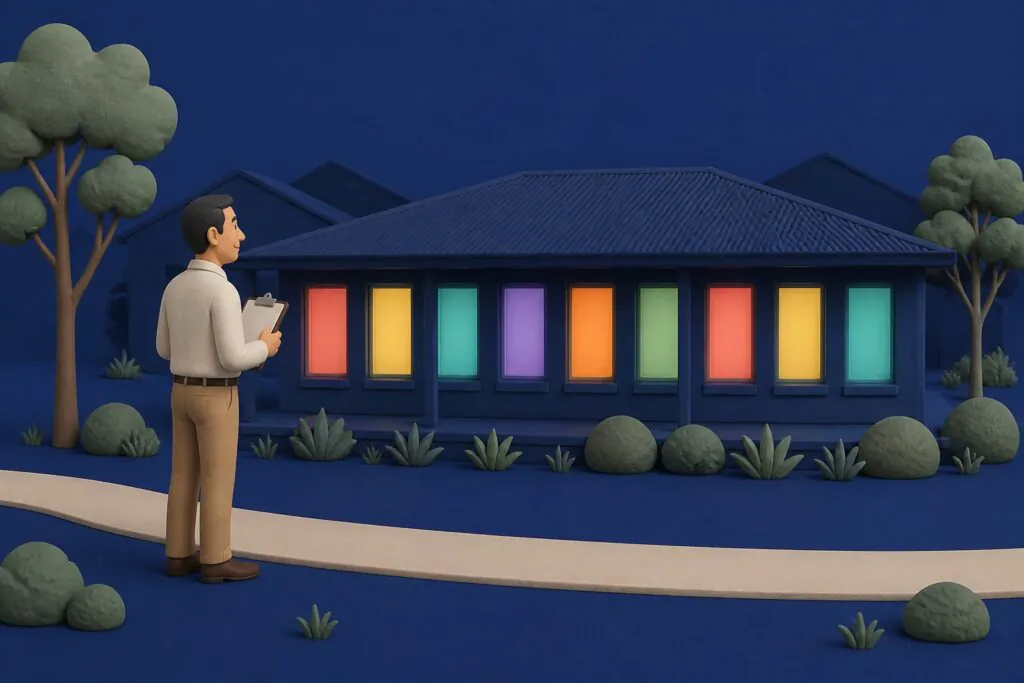
Answering: Why is a purpose-built co-living property nine rooms, and how do Victorian planning rules and nine separate leases shape that number?
Estimated reading time: 12 min read
Nine rooms is the largest bedroom count Victoria’s Clause 52.23 planning exemption allows for a domestic-scale rooming house, and it is how one title becomes nine separate leases instead of one. That is the shape. It is not a slogan.
If you have been comparing operators, nine bedrooms keeps turning up as if someone picked a lucky number. The Harmony Group designs a purpose-built nine-bed because that number sits at the planning cap, fits the Class 1b building ceiling, and turns one knock-down-rebuild site in Melbourne’s middle ring into nine rooms and nine bathrooms on one title. The team describes that whole package as The Harmony Formula: nine bed, high-end, good location, established area.
The rent roll follows the same shape. Nine people live in the building, each on their own lease. A specialist property manager runs it. You own the whole building. What that may earn, and what it costs to get there, only makes sense after the planning and the leases are plain.
Key Insights
- Victoria’s Clause 52.23 caps a planning-exempt rooming house at nine bedrooms, 300 square metres and 12 residents. Ten bedrooms leaves the exemption.
- Nine rooms on one title means nine leases, not one household tenancy. That is the income reason for the number.
- 11.36%, based on recent acquisitions, is a gross figure on the base project cost. It is not a net return.
- The build is drawn to that envelope: nine rooms, nine bathrooms, single storey, two executive rooms, shared living space.
- More tenants means more work. A specialist manager runs the building. Co-living is not for everyone, and the team will say so.
Table of Contents
- Nine rooms starts as a planning number
- Nine leases on one title change the rent roll
- The building is drawn to that envelope
- Location is the other half of the Formula
- What The Harmony Formula actually puts together
- The honest trade-offs of a nine-bed
- Frequently Asked Questions About Nine Rooms
Nine rooms starts as a planning number
Clause 52.23 of the Victoria Planning Provisions exists to facilitate domestic-scale rooming houses. It has two exemptions: one for using land as a rooming house, which covers ten residential, commercial and centre zones, and one for the buildings and works, which covers a narrower list of six residential zones. Where both apply and every listed condition is met, a rooming house can be used and built without a planning permit. Two of those conditions set the number you keep seeing: no more than nine bedrooms, and no more than 12 persons accommodated. The floor area of all buildings on the land must also stay at or under 300 square metres, excluding outbuildings.
The exemptions only reach a building that is a rooming house as the planning scheme defines it, by reference to the Residential Tenancies Act 1997. Wyndham’s definition guidance treats a room with its own kitchen, bathroom and toilet as a self-contained apartment rather than a room, and allows at most two of those in a nine-bedroom rooming house.
Wyndham City’s published guidance treats the bedroom, floor-area and resident caps as a package with the rest of the clause: bedrooms reached from a shared entry inside the building, a minimum garden area in the General Residential Zone, and shared facilities that include a kitchen and a living area. Miss one condition and the planning-permit exemption does not apply. A tenth bedroom is the cleanest way to fall out.
That is the planning reason nine is the number. Eight rooms can also sit inside the exemption. Twelve rooms cannot. Nine is the largest bedroom count the statewide provision allows without a planning permit, while still leaving room for shared living space inside the 300 square metre cap.
The exemption does not cancel the rest of the stack. Wyndham is explicit: you must still obtain a building permit and register as prescribed accommodation with council. Operator licensing with Consumer Affairs Victoria sits on a different statute again. The licence, registration and Class 1b article walks those layers. For the number nine, the planning cap is what matters: it is one reason the product is designed around nine rooms rather than ten.
Class 1b, under the National Construction Code, uses a similar ceiling. The Australian Building Codes Board describes a Class 1b building as a boarding house, guest house or hostel with a floor area less than 300 square metres that ordinarily has less than 12 people living in it. A nine-bed drawn to Clause 52.23 also sits inside that classification envelope. Classification is not a planning permit, and a planning permit is not classification.
Nine leases on one title change the rent roll
Planning explains the cap. Income explains why the team builds to the cap rather than stopping at six or seven rooms.
A standard investment house at the same $1.5 million price is usually one tenancy. Average figures based on most recent projects. That comparison house is put at $865 a week in total, or $45,000 a year, which is a 3% gross yield. One household, one lease, one rent.
A purpose-built nine-bed is one title and nine leases. Each room has its own bathroom. Shared living space sits alongside the rooms because the planning clause requires common areas, including a kitchen and living area. Nine people live in the building, each on their own lease. A specialist property manager runs it.
Average figures based on most recent projects. Weekly rent per room is shown as around $380. The average behind that rounded figure is $382.50. Across nine rooms and 52 weeks, $382.50 times nine times 52 equals $179,010 in gross annual rental income. The base project cost is $1,574,000. Project cost including additional considerations is $1,650,250. 11.36%, based on recent acquisitions, is the gross yield on that base project cost. It is not a net figure. Interest, rates, insurance, management, maintenance and vacancies sit under the line.
A second figure answers a different question: 10.8% is the historical average gross yield across The Harmony Group’s delivered projects.
Co-living investment requires a minimum of $600,000 in cash, usable equity, or a combination of both. Clients pay Harmony $0. Builders pay the same fee at settlement.
That is the income reason for nine rather than one. It is also why the number only works if the building is designed for nine separate occupants from the start, and if someone competent runs the nine leases. Income that arrives while you are still working, rather than after you stop, depends on those two things holding.
The building is drawn to that envelope
A purpose-built nine-bed is not an ordinary house with extra doors. It is one knock-down-rebuild on a single title: nine rooms, nine bathrooms, single storey, with two executive rooms, plus the shared living space the planning clause asks for.
The team describes the Build Formula at principle level only. An exclusive partner network does the work: architects, a builder, hotel fit-out specialists, and specialist property managers. The non-negotiables are the ones that keep the building inside the envelope: nine rooms, nine bathrooms, single storey, two executive rooms, and a seven-year structural guarantee. The point is that the floor plan is drawn to nine before a wall goes up.
Single storey is a Build Formula non-negotiable; the 300 square metre test counts the total floor area of all buildings on the land. Internal access from a shared entry is how each bedroom is reached. Shared living space is not a leftover lounge. It is a required common area. Two executive rooms sit inside the same nine-room cap. They do not add a tenth bedroom.
You own the whole building. It is not a fund, not a syndicate, and not a share of something. Nine people live in it, each on their own lease. That ownership shape is how Harmony’s co-living is set up: one dwelling, nine rooms, one owner.
Location is the other half of the Formula
Nine rooms on the wrong site is still the wrong project. The Harmony Formula’s other two terms are good location and established area. Those are not slogans either. They are a site test.
The 118-point method is how the team chooses the site. It asks 118 questions across Market, Area and Property before a block is treated as a candidate. It scores market analysis, area selection and property specification. The planning test sits beside it: a site that cannot carry a domestic-scale rooming house is the wrong site, no matter how the render looks. Garden area in the General Residential Zone is a site question, not a fit-out question. So is whether the zone is one the Clause 52.23 exemptions actually cover.
We build in Melbourne. Our investors come from every state. The planning rule is Victorian. The investor does not have to live in Victoria to need the shape explained. The process can run remotely. A specialist manager runs the building after settlement.
The team brings 15+ years of specialist accommodation experience.
What The Harmony Formula actually puts together
The Harmony Group’s definition of The Harmony Formula is nine bed, high-end, good location, established area. It is the team’s term for the whole shape, not a substitute for the 118-point method. The method chooses the site. The Formula is what has to be true of the project that lands on it.
Nine bed is the planning and income number. High-end is the build quality inside that number: purpose-built rooms, nine bathrooms, two executive rooms, a seven-year structural guarantee, hotel-fit-out partners rather than a leftover house plan. Good location and established area are the 118-point outcome: a middle-ring Melbourne site that can carry a domestic-scale rooming house and be run as nine leases.
Take any piece away and the product is different. Eight rooms still plans, but it is not the cap and it is not this product. Ten rooms leaves the planning exemption. A cheaper fit-out inside nine rooms is a different building. A site that fails the method is the wrong block, even if someone could physically draw nine bedrooms on it.
Smaller configurations are not Harmony’s product. The team builds the nine-bed. That is the honest limit of the Formula, not a menu of sizes.
The honest trade-offs of a nine-bed
Nine leases are more work than one. Vacancies, house rules, repairs and the day-to-day running of shared space do not manage themselves. That is why a specialist property manager runs the building. It is not a house you leave on autopilot, and it is not a job you should take on from interstate without that manager in place.
Regulation is thicker than a standard rental. Planning exemption, if the clause is met, still leaves a building permit, an occupancy permit, council registration as prescribed accommodation, operator licensing, and the rooming house minimum standards. Class 1b is another layer, not a shortcut around those. Anyone who tells you nine rooms means no approvals is not describing Victoria.
Lending is its own conversation. Banks and valuers treat a nine-bed differently from a three-bed house. Serviceability, the way the rent is counted, and how the security is viewed all sit with your broker and the lender.
The product is also a concentration. You own one building, in Melbourne, designed a particular way. It may suit an investor who wants income that arrives while they are still working, and who is prepared to own a regulated, multi-lease building. It may not suit someone who wants a single household tenant, a different city, or a share of a fund. If co-living is not suitable, the honest answer is to say so.
Frequently Asked Questions About Nine Rooms
Q: Why not eight rooms, or ten?
Eight rooms can sit inside Clause 52.23. Ten rooms cannot, because the bedroom cap is nine. Nine is the largest count the statewide exemption allows, while still leaving shared living space and a 300 square metre floor area to work with. That is the planning reason the team puts “nine bed” first in The Harmony Formula. Smaller configurations are not Harmony’s product.
Q: Is nine rooms only about planning?
No. Planning sets the cap. Income is why the team builds to the cap. Nine rooms on one title become nine leases. Average figures based on most recent projects. Nine rooms at an average of $382.50 a week, shown as around $380, times 52 weeks, give $179,010 in gross annual rental income. A standard $1.5 million house is compared at $45,000 a year and a 3% gross yield.
Q: How is 11.36%, based on recent acquisitions, worked out?
It is the gross yield on the base project cost of $1,574,000. Average figures based on most recent projects. $179,010 divided by that base cost gives the figure. It is not net of interest, rates, insurance, management, maintenance or vacancy. It is not a forecast.
Q: Does a nine-bed still need other approvals if planning is exempt?
Yes. A planning-permit exemption is only an exemption from the planning permit. A building permit, occupancy permit, council registration as prescribed accommodation and a licensed operator still apply. Consumer Affairs Victoria is clear that operator licensing does not replace council registration. Class 1b classification sits in the building permit, not in the planning clause.
Q: Can I own the nine-bed if I do not live in Melbourne?
Yes. We build in Melbourne. Our investors come from every state. The process can run remotely. A specialist property manager runs the building. Minimum funds are $600,000 in cash, usable equity, or a combination of both.
Learn the nine-bed shape before you talk
If you want the planning cap, the nine leases and the Formula in one place, start with Harmony’s free co-living education program. The core takes about 45 minutes. It covers what you would own, how a purpose-built nine-bed is designed and run, and where planning and management sit. Finish any 9 modules and a booking link opens for a one on one with one of the directors. If co-living isn’t suitable for you, we’ll tell you why.
Related reading on the Formula, planning and the nine-bed
- What The Harmony Formula is, and why it produces nine-bed properties
- Rooming house licence, council registration and Class 1b in Victoria
- The 118-point method, and how the site is chosen
- What a Harmony co-living building actually is
- What Class 1b certification means for a co-living investor
Citations
- Clause 52.23 Rooming House, Victoria Planning Provisions, Brimbank Planning Scheme extract via planning.vic.gov.au
- Exemptions, Wyndham City Council
- Is my proposal a Rooming House?, Wyndham City Council
- Building classifications, Australian Building Codes Board
- Rooming house operators licensing scheme, Consumer Affairs Victoria, last updated 9 April 2024
General information only. The Harmony Group provides general information about property and co-living investment, not personal financial, tax or legal advice, and does not hold an Australian Financial Services Licence (AFSL). It does not account for your objectives, financial situation or needs, so consider its appropriateness and seek advice from a licensed financial adviser, mortgage broker, accountant or the ATO before acting. Past performance is not a guide to future results and historical figures may not be repeated. The 2027 negative gearing reform was enacted on 26 June 2026 and applies from 1 July 2027. The definition of a new residential dwelling is still being settled after Treasury’s consultation, so whether a nine-bed is an eligible new build remains unsettled. Other tax or regulatory measures described are subject to change.